Archform Studio — Building a web presence that communicates process, not just visuals
A boutique architecture and interior design firm in Ghent with four years of work and no website beyond a Squarespace placeholder.
The situation
Archform Studio had been operating since 2020, taking on residential and commercial architecture projects in Belgium and the Netherlands. They had an established client base built through referrals and a body of work they were genuinely proud of.
The problem wasn’t that they lacked clients. It was that when potential clients went to check them out online, they found a Squarespace placeholder with a name, an email address, and nothing else. For a practice charging professional fees for high-consideration work, this created a credibility gap.
They’d put off building a site partly because they didn’t know what it should say. Architecture portfolio sites tend to be either image galleries (beautiful, no information about how the firm actually works) or text-heavy practice descriptions (professional, very boring). They wanted something between the two.
The brand identity challenge
Before the site could be designed, we needed a visual system. Archform had no existing brand assets beyond a wordmark their founder had set in a clean sans-serif, which we decided to keep and refine rather than replace.
Architecture firms operate in a space where visual credibility matters significantly. A brand that looks too minimal signals inexperience. A brand that looks too polished signals a larger practice with higher overhead. The target: established, considered, not trying too hard.
We landed on a type-led system with a refined wordmark alongside a geometric secondary typeface for body text and captions, with a palette of near-black, warm white, and a single accent drawn from the natural stone tones in their project photography. No illustration, no graphic elements beyond the type.
Site architecture decisions
Architecture portfolio sites have a structural problem: organise by project type and you end up with thin categories. Show everything in a single grid and there’s no way to orient a visitor looking for specific work.
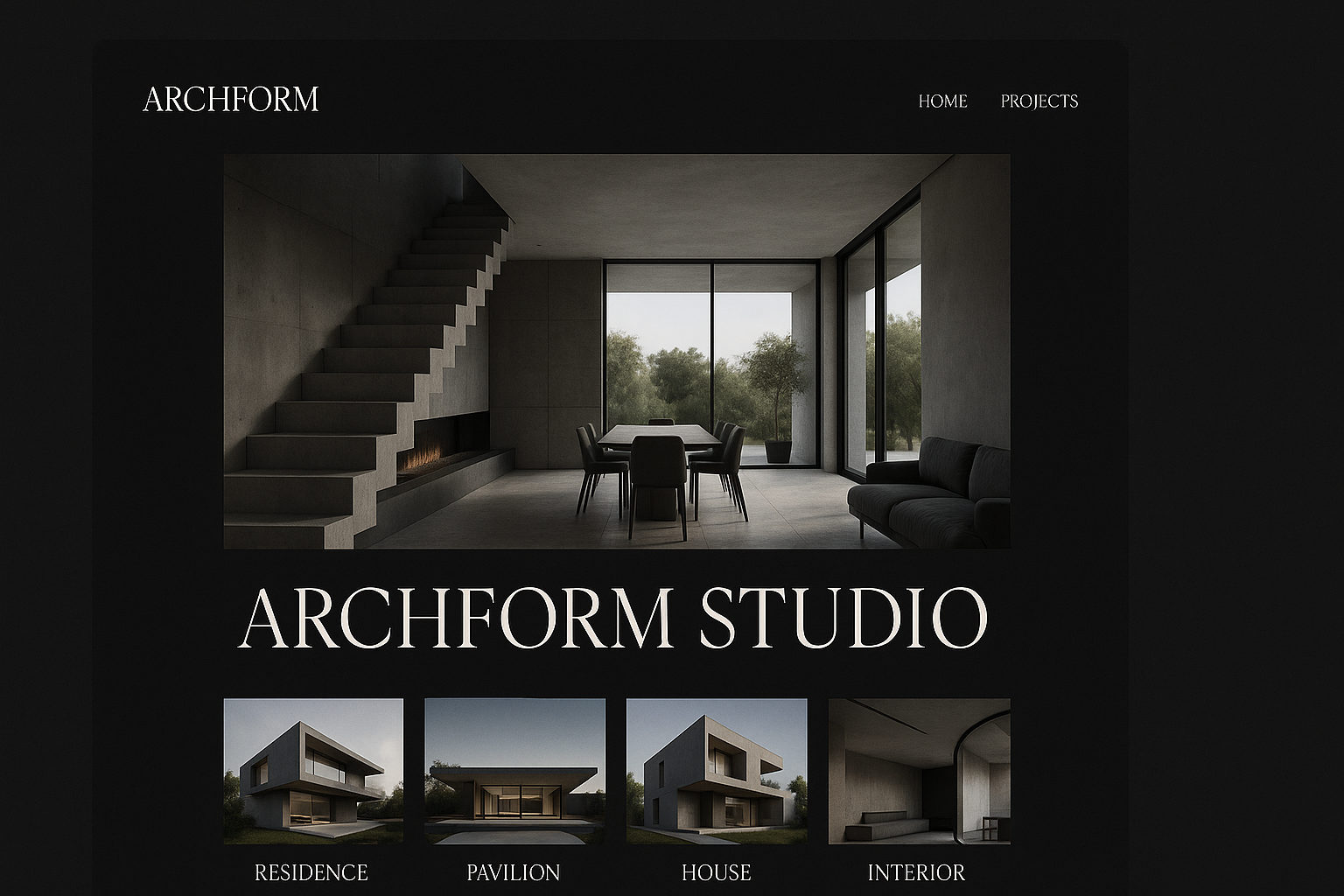
We structured the portfolio with a primary grid showing all projects, filterable by category, with each project getting its own page. Project pages were designed to communicate two things in parallel: what the space looks like (photography, prominent), and how the firm thought about the problem (written sections covering brief, approach, decisions made).
Showing beautiful spaces is necessary but not sufficient. The clients who choose you based on photography alone will also choose someone else based on photography. The ones who read how you think are more likely to be the clients you want.
The enquiry form was designed to give Archform enough information to respond meaningfully without a preliminary call — asking about project type, timeline, and location to filter out enquiries that aren’t a fit.
The build
Built in Webflow with a CMS structure for projects. Each project has a consistent template — cover image, project metadata, photography gallery, written sections — flexible enough that projects of different scales look natural rather than forced into the same mould.
Archform can add new projects themselves, which matters for a practice that completes several projects a year. The enquiry form connects directly to their email, with a confirmation email to the sender setting expectations about response time.
What we’d do differently
The project filtering was implemented using Webflow’s native CMS filtering. The interaction on mobile is less elegant than we’d like. A custom JavaScript filter would give us more control; we’d build it that way on a similar brief now.
We also scoped project pages with a single photography gallery. Several of Archform’s projects have a process story involving construction photography and drawings that would benefit from a second gallery section. Something to design in from the start next time.
Starting from scratch?
Building a first proper site is one of the most common briefs we get. We know what decisions matter and which to defer.
Talk to us